
The
Functional
Reconstruction of the
Antikythera
Mechanism
Geared Computer of the Hellenistic Era
—— A Lunisolar Time Calculator
The Antikythera Mechanism is an ancient Hellenic geared device, dating back to around 180 BCE. It is often considered the world’s first analog computer.
Captain Dimitrios Kontos of Symi island and his crew of sponge divers discovered a shipwreck (1900) in Antikythera Island, located between Crete and Peloponnese. The shipwreck was a Roman-era (~80 BCE) large cargo ship, named Olkas which carried a large number of goods (bronze and marble statues, glass plates etc.). The Antikythera Mechanism was recognized as a strange machine when it had been deposited in a place of the museum in 1901. The device was encrusted and totally corroded after centuries underwater. Archaeologists later identified its intricate gears and inscriptions, revealing its purpose as an ancient astronomical Time calculator, astonishing the world with its complexity and sophistication. Today, the fragments of the Antikythera Mechanism are exhibited in the National Archaeological Museum of Athens, Hellas.
The intricate bronze gears, axes, scales and pointers were used to predict the phases of the Moon, the timed position of the Sun in Ecliptic, the solar and lunar eclipses (day and hour), and calendar events, showcasing the advanced engineering and astronomical knowledge of the Hellenistic period.
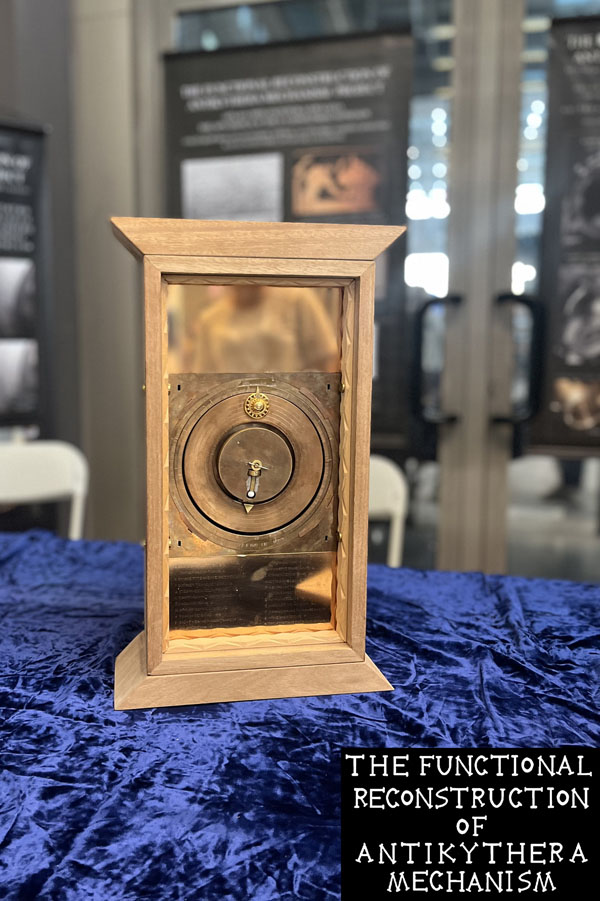
Research history
This strange machine, with gears, axes, scales and inscriptions attracted the interest of researchers since its discovery. Inscriptions suggest it was built around 150-100 BCE.
Ongoing research continues to uncover its precise I. Svoronos, A. Rehm suggested their opinion about this unique device. I. Theofanidis made an attempt for the reconstruction of the Mechanism. Derek J. de Solla Price: In the 1950s-1970s, he conducted pioneering studies, proposing it was an ancient analog computer. Michael Wright: In the 1980s-2000s, he advanced understanding of its gearwork and functionality using CT scans.
The re-investigation of the Antikythera Mechanism by initiative of Professors
M. Edmunds (Cardiff University, United Kingdom), J.H. Seiradakis (Aristotle University Thessaloniki, Hellas) and X. Moussas (National Kapodistrian University of Athens, Hellas) in collaboration with the National Archaeological Museum of Athens, Hellas, started in 2003-2004 via The Antikythera Mechanism Research Project (AMRP): A large heavy X-Ray tomograph was used in order to reveal the internal secrets of the Fragments of the Antikythera Mechanism. AMRP shed light to many unknown aspects and unanswered questions that had troubled scientists for many years (and also was created new questions!).
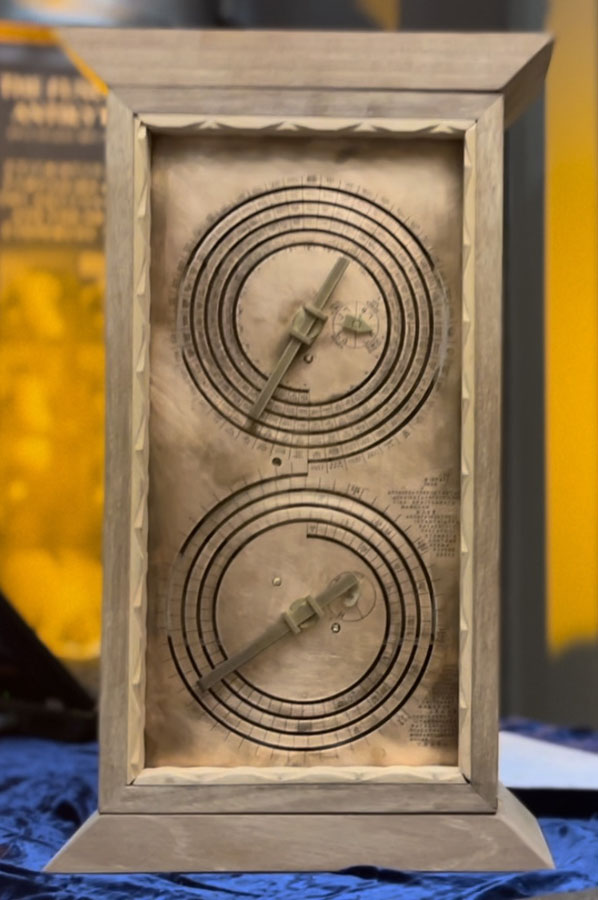
Our Goals
The Frame Project Team
9 years of research
15 Publications
Dr. Christophoros Mouratidis – Assistant Professor at Merchant Marine Academy of Syros, Hellas: Software, Image process and data visualization, Mathematical analysis.
Aristeidis Voulgaris – City of Thessaloniki, Directorate of Culture and Tourism, Hellas: Investigation, Mechanics, Bronze reconstructions, Image and X-ray tomography process.
Andreas Vossinakis – Graphics designer, Hellas: X-ray tomography process, Graphics.